

THE ROMAN THEATRE IN CARTAGENA SPAIN

The regeneration project of the Roman Theatre in Cartagena has taken into account the integration of the remains in the urban network, as well as its adequate preservation and presentation for learning and cultural purposes. Also, the considerable wealth of the pieces for the successive excavation campaigns discovered in the Theatre have given the opportunity to provide the city with a new museum space, the Roman Theatre Mvseum, that not only serves as an adequate exhibition framework, but also, in the bright concept of the architect Rafael Moneo, leads the visitors to the interior of the monument, converting the Roman Theatre into its ultimately great hall.
History of discovery
From the beginning, the discovery and excavation of the Roman Theatre of Cartagena has become in one of the most amazing finds the town’s archaeology, demonstrating the important role that the town of Cartagena played in the history of Old Spain (Hispania Antigua).
The archaeological excavations carried out since 1998 on the northwest slope of the Cerro de la Concepción have made it possible to discover and understand the Roman monument’s exceptional architecture, decorative elements and significance, but they have also provided vital information for piecing together over twenty centuries of the city’s history.
The singular superimposition of the so-called Old Cathedral (Santa María la Vieja) on the theatre cavea is the end result of a complex succession of neighbourhoods and structures that have made this area of the city a veritable history book written in the language of material traces and objects from everyday life.
In the modern era, all of this area was occupied by a humble yet lively residential neighbourhood dating from the 19th century, which over the years had become one of the poorest and most deteriorated areas of the city centre. Therefore, the recovery of the archaeological remains was not merely a research project but also the catalyst that inspired the regeneration of a large part of the city.
Systematic excavation commenced in 1988 in this part of the old city as a result of the construction of the Regional Crafts Centre on the site formerly occupied by the Palace of the Countess Peralta, which had been demolished two years earlier.
The work carried out between 1989 and 1990 uncovered a complex superimposition of structures and furnished a wealth of material evidence that confirmed the monumental nature of the archaeological remains, especially following the recovery of an impressive monumental lintel with an inscription dedicated to one of Augustus’ adopted sons.
The date 6 February 1990 marked a milestone in the history of archaeological research into the Romanisation of the southeast Iberian Peninsula, when the structures found at the site were identified as the ruins of a Roman theatre. Once the significance of the find as part of Cartagena’s cultural heritage became clear, the archaeological excavations began.
From 1994 on, the work progressed with few interruptions, and a structured calendar of activity was defined in 1996 in a collaboration agreement signed by the Regional Government of Murcia, Cartagena City Council and Fundación Cajamurcia.
Over the years, 1996-2003, of adherence to the annual intervention schedule, almost the entire theatre was excavated and revealed in all its magnificence and splendour.
The monument and its parts
The location on the hillside facilitated the building of the stands, as the central and lower parts of the cavea was built into the base of the hill, while the lateral sides supported vaulted galleries.
The cavea, with a capacity of 7,000 spectators, had a maximum diameter of 87m, was split into three areas, or maeniana, divided vertically by five sets of steps in the ima (lower stands) and nine sets of steps in the media and summa cavea (middle and upper stands).
The main public access was made through two side corridors (aditus) over which rested lintels dedicated to Lucio Caesar (on the eastern side) and probably, Caio Caesar (on the western side). Both dedications, together with the inscription consul designatus en el cursus de Caio on one of the coins found in the hyposcaenium pit, indicates that the building was most probably in use between 5 and 1 B.C.
These side corridors also allowed access to the orchestra: this semicircular space in front of the stage or proscaenium contains three rows of seats (proedria) reserved for important members of the public. The proscaenium itself, where the actors appeared together with the choir, extends to a length of 43.60 m. The stage was finished at the front with jointed segments by means of exedrae, under which there was a vaulted drain to remove rainwater, with three central drains connected to two channels located at the ends of the circulation duct, at the foot of the ima cavea.
From the analysis of the residual impressions and architectural remains, the scaenae frons or stage façade was located opposite the stands. It had a floor joined by three curved exedrae with elevations of 14.60 m. in height and two fronts, in which the combination of the reddish tones of the columns, the white of the capitals and bases and the grey of the podium and entablature will display an impressive play of colours. At the back, the porticus post scaenam, rose in terraces culminating in a double porticoed gallery surrounding a central garden.
The building quickly became an essential part of the old town’s landscape. The quality of its materials; its bases, its cornices and especially its capitals, demonstrate the importance of the building, and along with its rich ornamental programme, makes the Theatre of Cartagena a magnificent example of the public and monumental architecture during the Augustinian period in Hispania.
The restoration
Following the archaeological recovery of the Roman theatre, a process of analysis and discussion was begun in order to define the guidelines for work on the monument itself. This process of debate examined the most recent examples of recovered theatres from Antiquity and the challenges that conducting a restoration in the early 21st century would pose.
After this time of reflection, it was decided that the main purpose of the restored theatre would be to serve as a monument open to visitors, brought back to life to be contemplated and enjoyed by society, and as an exponent of the identifying traits of Roman Cartagena.
The restoration has adhered to a basic criteria primarily aimed at offering a clearer understanding of the monument to visitors:
1. Which has necessitated reconstructing remains of the stands that had completely disappeared without changing the original appearance,
2. Whilst simultaneously reinforcing the original conservation work.
3. Finally, the entrances have been replaced for visits and tours of the inside of the building. Moreover, the stage façade has been partially restored along with its original elements.
Although the restoration can claim reversibility, there has been an attempt to minimise the material impact as much as possible.
A. The restoration is reversible because all possible measures have been taken to guarantee that the new work can be dismantled without any kind of damage to the original work. With this in mind, any new work has been separated from the original work by means of strips of geo-textile fibre allowing sufficient separation for the new work to be removed if necessary.
B. In order to reduce the material impact, authentic materials have been used, and contemporary Roman techniques have been employed wherever possible in the construction of the building. Lime mortar, made with washed sand from the river, and containing andesites, lime-stones and phyllites from extra-milled rock has been used. Furthermore, only locally quarried stones, as would have been used in antiquity, have been included.
Professionals from various fields, architects, archaeologists, restoration experts and many other skilled workers participated in the restoration work, we must also highlight the interdisciplinary nature of all decisions


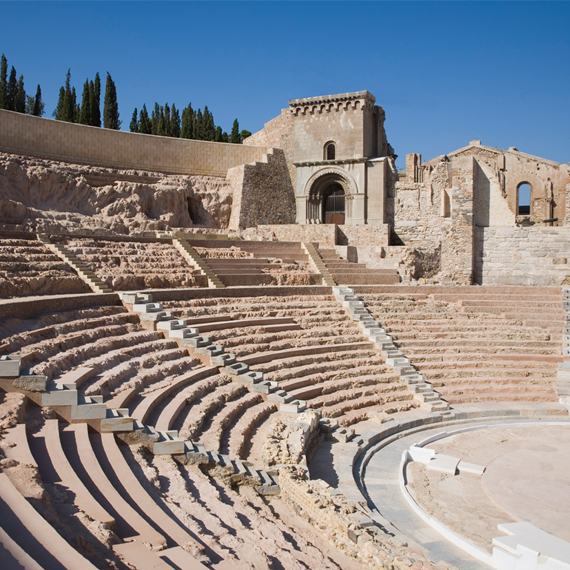
♦ The Roman Theatre in Cartagena in 1991 ♦ The Roman Theatre in Cartagena in 1997 ♦ The Roman Theatre in Cartagena in 2000
———————————————————————————————————————————————————————-

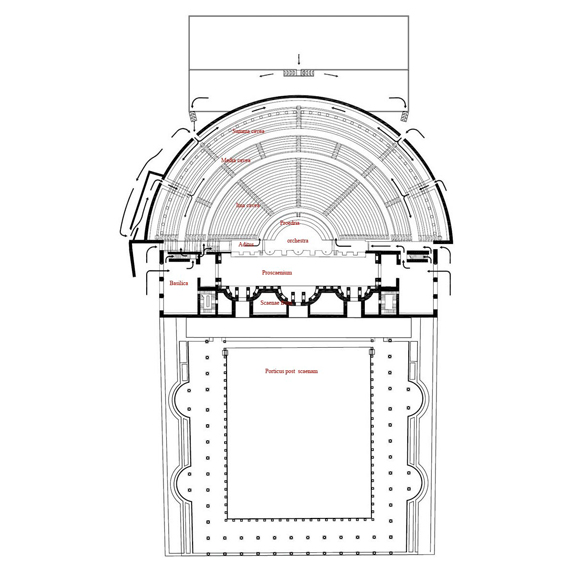
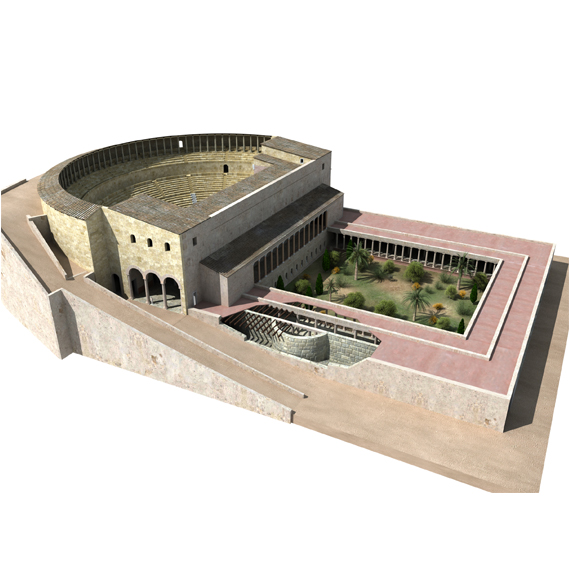
♦ The Roman Theatre in Cartagena in 2006 ♦Restitution of the plant ♦ Virtual image of the theatre and post scaenam portico
——————————————————————————————————————————————————————-
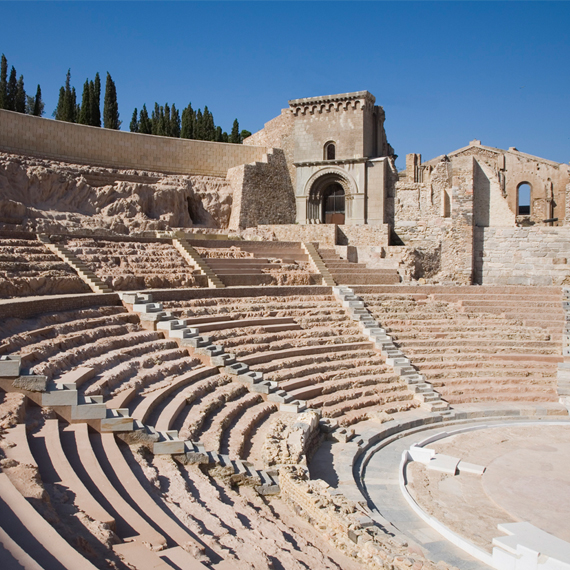
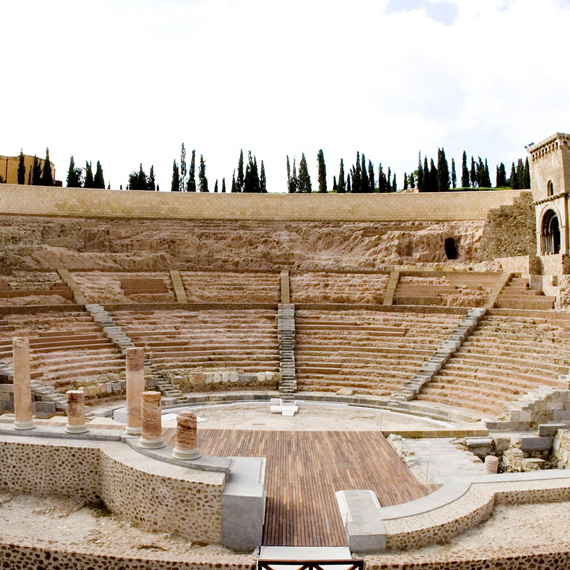
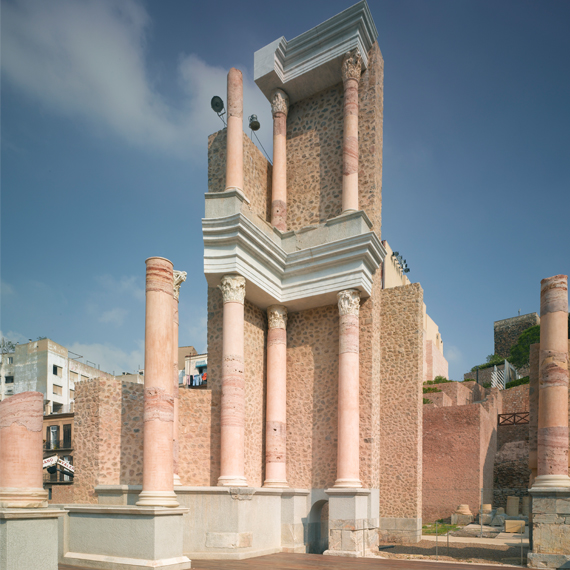
♦The Roman Theatre of Cartagena ♦Consolidation of the cavea ♦The restoration of the scenic facade
——————————————————————————————————————————————————————
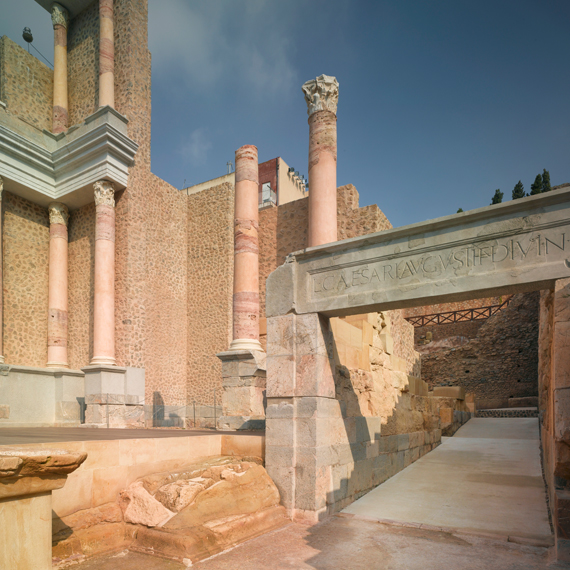
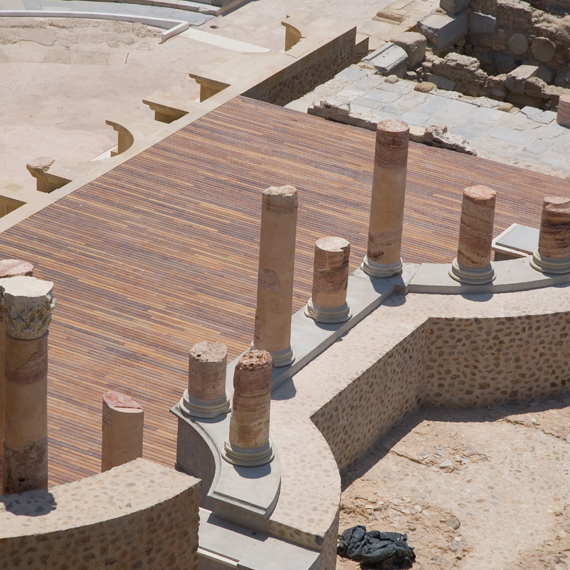
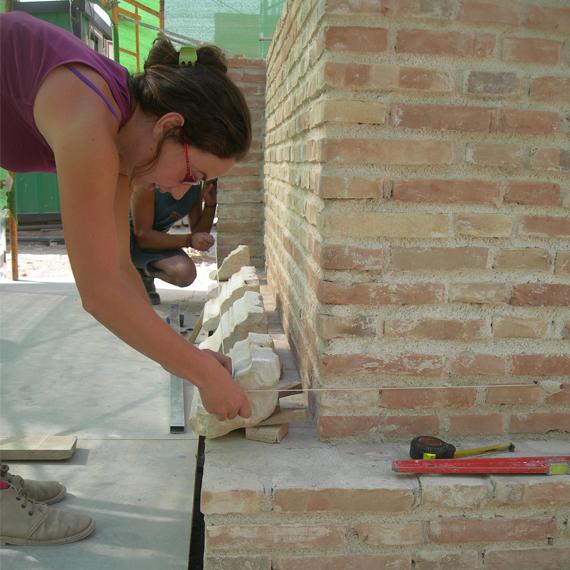
♦ The restoration of the scenic facade ♦Anastylosis ♦ The restoration work
———————————————————————————————————————————————————————-
Info: http://www.teatroromanocartagena.org/
 November 6, 2015
·
 dobrina ·
 Comments Closed
 Tags: The regeneration project of the Roman Theatre in Cartagena; Rafael Moneo · Posted in: Актуална информация, Други, Публикации на други езици, Текстове на други езици, Фотографии