

ФОРМООБРАЗУВАНЕ ЗА ЛЮБОЗНАТЕЛНИ
Subdivision: Platonic Solids
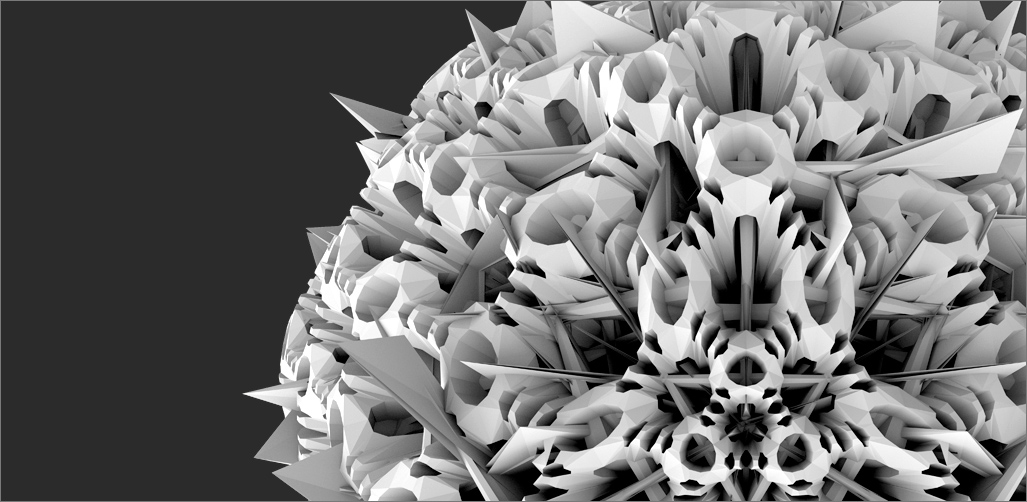 How can a purely operations-based geometric process can generate complex form? This project begins with the most primitive forms, the platonic solids, and repeatedly employs a single operation – the division of a form’s faces into smaller faces – until forms of an astounding complexity are produced.
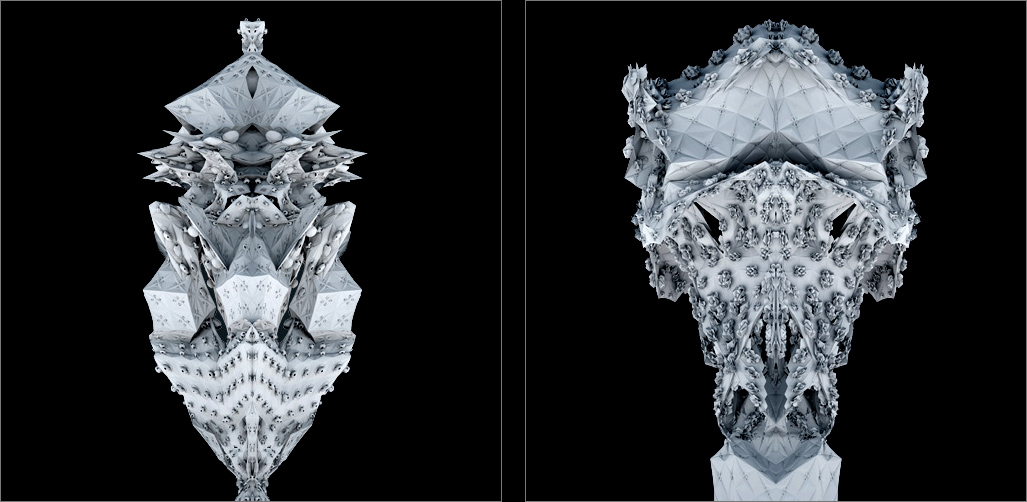
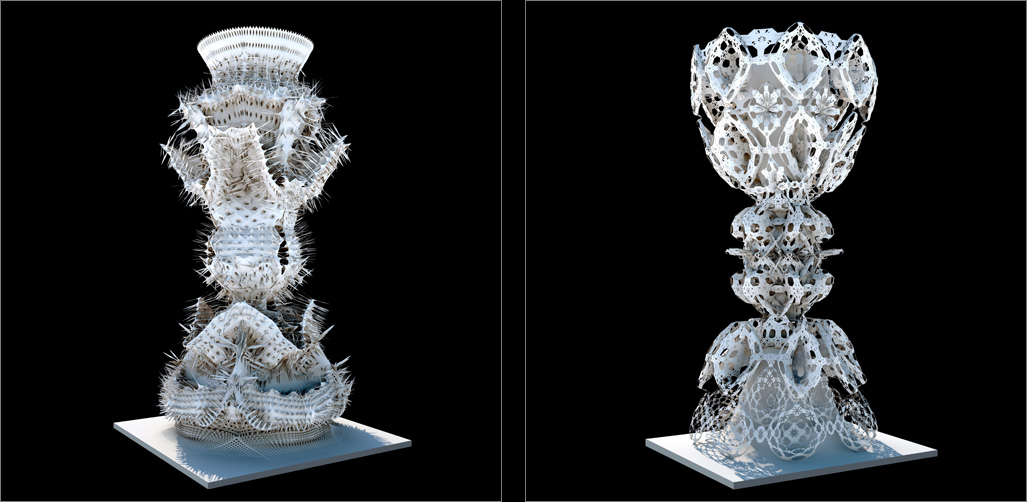
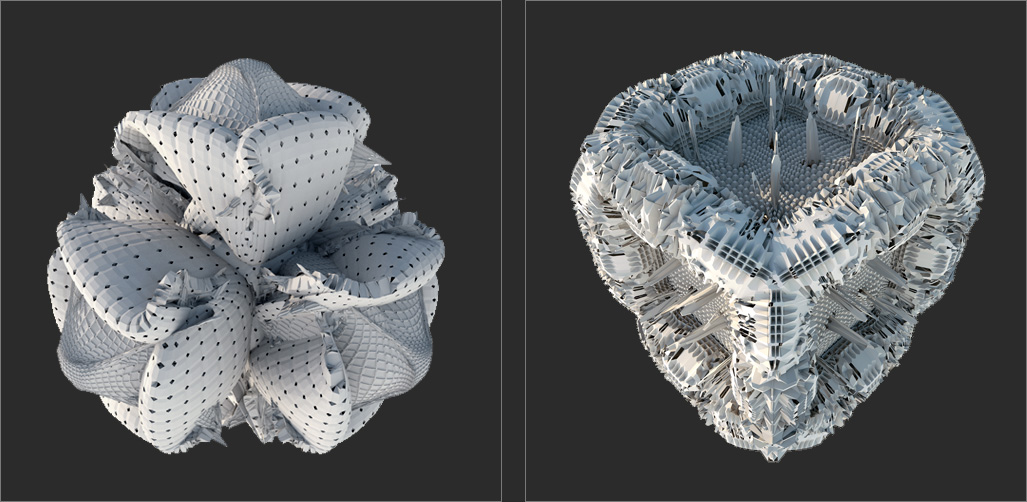
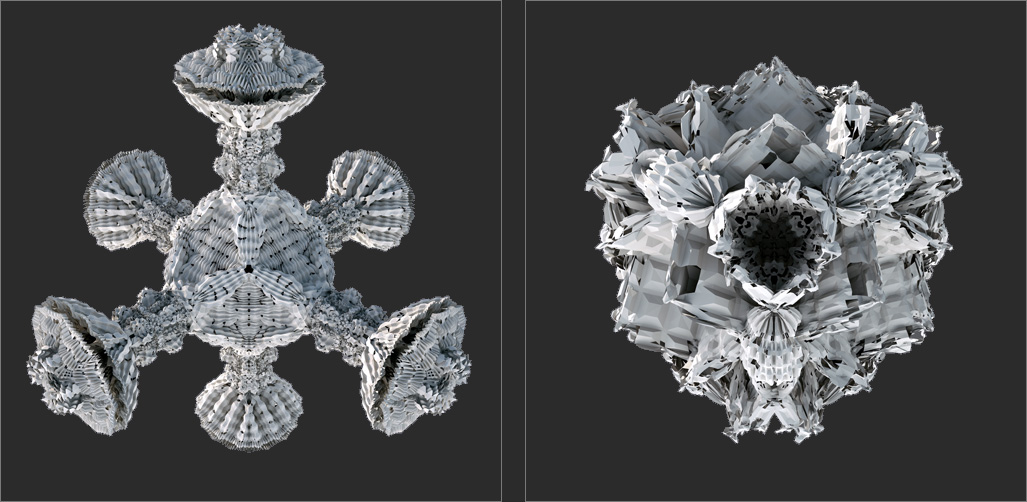
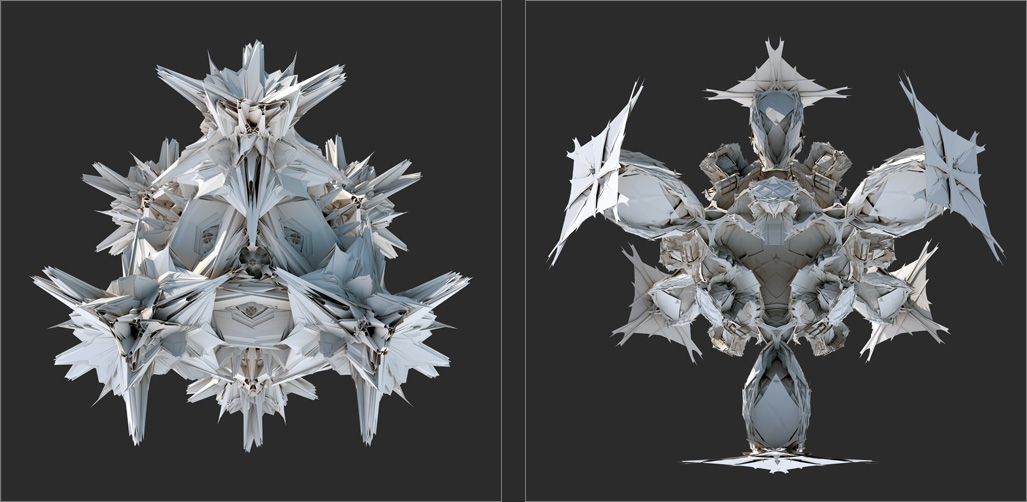
Platonic Solids (2008)
The Platonic Solids project explores how a purely operations-based geometric process can generate complex form. Rather than studying the possibilities in combining numerous primitives, this project examines the potential inherent in a single primitive given an appropriate process. It takes the most primitive forms, the platonic solids, and repeatedly employs one single operation – the division of a form’s faces into smaller faces – until a new form is produced.
All of the forms shown are generated using the same single process, Only the variables that control the process’ division operation are allowed to change. This single process affects both the form’s topography and topology. It influences attributes such as the degree of branching, porosity, and fractalization – just to name a few. The process also works at multiple scales: it affects not only the overall shape, but it determines the surface development as well as the generation of miniscule textures.
The resulting forms display a novel aesthetic and an astounding complexity that largely defies attempts at reductionism.
Platonic Solids – Technical Background
The processes at the core of this project are the Catmull-Clark and Doo-Sabin algorithms. They were both conceived of in the late 1970’s with the aim of generating smooth surfaces from coarses polygonal meshes.
The processes can be understood by considering their two parts: topological rules and weighting rules. The topological rules specify how to obtain the combinatorics of the refined mesh from the combinatorics of the input mesh by generating new vertices, edges and faces. The weighting rules specify how to calculate the positions of these new vertices based on interpolation between vertices of the input mesh.
By introducing parameters to allow for variations in these weighting rules, non-rounded forms with highly diverse attributes can be produced. Whereas the traditional weighting rules specify the positions of new vertices strictly as interpolations of previous-generation vertices, these rules are amended to allow for extrusion along face, edge and vertex normals. It is primarily through these two changes to the established schemes the complex geometries in this project become possible.
View the forms in 3D as anaglyphs (requires red-cyan glasses):
Platonic Solids Anaglyphs (Flash, 3Mb)
http://www.michael-hansmeyer.com/projects/platonic_solids.html?screenSize=1&color=0#1
Michael Hansmeyer Computational Architecture
Introduction
What method, what system, does an architect use to design a building? How are programmatic needs and context – with their degrees of freedom and constraints – translated into architectural design?
Regardless of their complexity, the tasks and decisions involved can be formalized as an algorithm. As such, algorithms provide a framework for articulating and defining both input data and procedures. This formalization can promote structure and coherency, while systemically maintaining full traceability of all input.
In recent years, algorithms in architecture have been able to transcend their role as frameworks of formalization and abstraction. This has been made possible in a large part by the integration of scripting languages into CAD programs. Algorithms’ output can now be directly visualized, and through digital fabrication methods this output can be built.
This opens up a new role for algorithms as a design tool. As such, they provide the benefits of depth and breadth. On the one hand, their computational power can address processes with a scale and complexity that precludes a manual approach. On the other hand, algorithms can generate endless permutations of a scheme. A slight tweaking of either the input or the process leads to an instant adaptation of output. When combined with an evaluative function, they can be used to recursively optimize output on both a functional and aesthetic level.
Yet beyond this, a computational approach to architecture enables the generation of the previously unseen. Forms that can longer be conceived of through traditional methods become possible. New realms open up.
The projects presented seek to explore algorithms and computation as a generative design tool, and to merge these with existing design processes to produce a new architectural form.
Biography Michael Hansmeyer is an architect and programmer who explores the use of algorithms and computation to generate architectural form. He is currently based in the CAAD group at ETH’s architecture department in Zurich. He holds an MBA degree from Insead Fontainebleau as well as a Master of Architecture degree from Columbia University. He previously worked with McKinsey & Company, J.P. Morgan, and at Herzog & de Meuron architects.
Michael Hansmeyer Computational Architecture
CAAD HPZ Floor F
Schafmattstrasse 32
8093 Zurich, Switzerland
email: contact (at) michael-hansmeyer.com
http://www.michael-hansmeyer.com/profile/about.html?screenSize=1&color=0
 March 22, 2011
·
 dobrina ·
 Comments Closed
 Tags: Computational Architecture; Platonic Solids ; How can a purely operations-based geometric process can generate complex form; · Posted in: Други, За студентите, Текстове на други езици